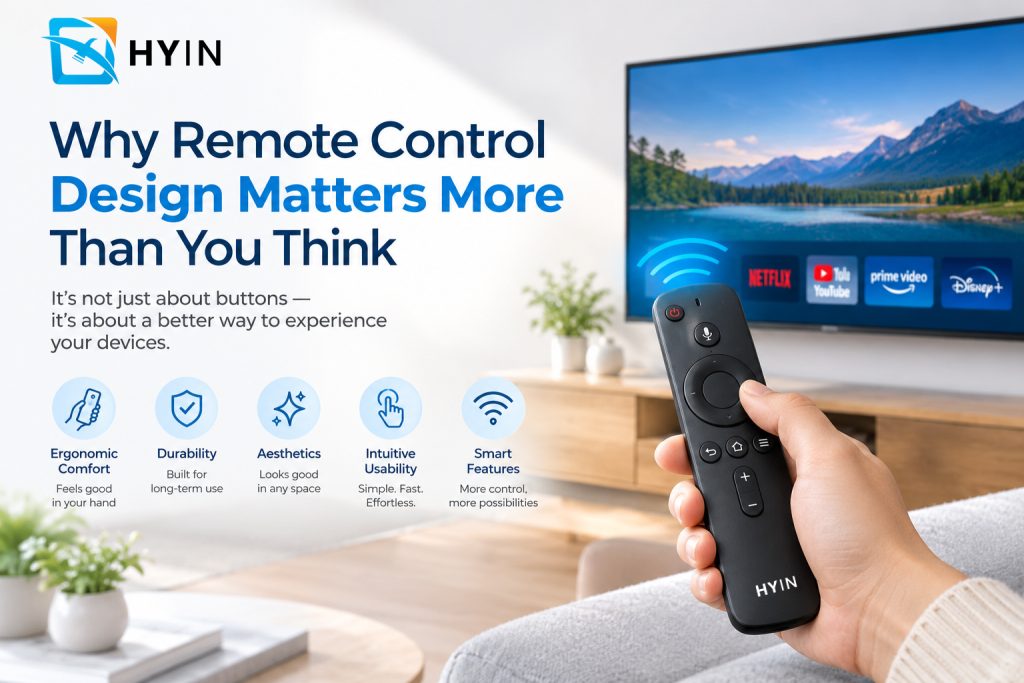
Why Remote Control Design Matters More Than You Think

A remote control is often one of the smallest components included with an electronic product. Yet it can have a significant influence on how customers use and perceive that product.
Consider a television with excellent picture quality but a remote that is difficult to navigate. Or an air conditioner with advanced functions that are hard to locate because the buttons are poorly arranged.
In both cases, the main product may perform well, but the user experience suffers. This is why remote control design deserves attention from the beginning of product development. It affects how easily users operate a device, how reliably commands are executed and how efficiently the remote can be manufactured at scale.
For brands developing consumer electronics, a well-designed remote control is not simply an accessory. It is part of the product experience.
1. Good Remote Control Design Starts with the User
The first question in remote control design should be simple: who will use it, and what will they need it to do? A television remote used daily by an entire household has different requirements from a specialised controller used to operate industrial equipment. An air conditioner remote may need to make temperature and mode adjustments easy to identify, while a smart TV remote may prioritise navigation, streaming shortcuts and voice search.
The intended user should influence the remote’s size, shape, button arrangement, labelling and overall functionality.
A remote with too many buttons can feel confusing. One with too few may force users to navigate several menus for basic tasks. The right balance depends on the product and the people using it.
User-centred design helps manufacturers identify these needs before finalising the product’s physical form.
2. Button Layout Can Make or Break Usability
Button placement is one of the most important aspects of remote control design. Users should be able to identify common functions quickly, understand what each button does and operate frequently used controls without unnecessary effort.
A thoughtful remote control button layout generally prioritises:
- Frequently used functions: Place essential controls where users can reach them easily.
- Clear grouping: Keep related functions together so users can understand the layout.
- Distinct buttons: Use suitable shapes, spacing, labels or textures to help distinguish controls.
- Readable markings: Ensure that symbols and text remain easy to identify under normal lighting.
- Reduced accidental presses: Provide sufficient spacing and appropriate button dimensions.
The design should also consider whether the remote will be used in low light, by older users or by people who may have difficulty distinguishing small buttons.
These details might seem minor during the design stage, but they shape the everyday experience of the product.
Research into ergonomic design for handheld consumer electronics has long highlighted the value of considering user needs systematically during product development.
3. Ergonomics Matters More Than Appearance Alone
A remote control can look modern and still be uncomfortable to use. Its length, width, weight, curvature, material and button feel all affect how it sits in the hand.
Remote control ergonomics is particularly important for products used frequently or over extended periods. A remote that feels too large, slippery or awkwardly balanced may frustrate users, even if its electronic functions work correctly.
Designers should consider the following questions:
- Does the remote fit comfortably in the intended user’s hand?
- Can the main buttons be reached without changing grip repeatedly?
- Is the weight appropriate for the product?
- Can users distinguish important buttons by touch?
- Do the materials offer a suitable balance of durability, grip and cost?
These questions should be evaluated through prototypes and user testing, rather than answered only through drawings or computer models.
A successful industrial design combines appearance with comfort and function. The goal is to create a remote that feels natural to use.
4. Internal Design Affects Performance Too
The external appearance of a remote control is only one part of the design process. The internal arrangement of components can influence connectivity, power consumption, reliability and ease of assembly.
For example, wireless remote controls require careful consideration of antenna placement and the surrounding components. Poor RF design can affect signal performance. Battery selection and power management influence how frequently users need to replace batteries. The placement of electronic components can also affect the size and shape of the finished product.
For Bluetooth and voice-enabled remote controls, additional factors may include microphone placement, pairing behaviour, firmware performance and compatibility with the receiving device.
Texas Instruments highlights low-power operation, wireless interfaces and user interaction requirements as important elements of modern RF smart remote control development.
This is why industrial design, electronic engineering and firmware development should work together. Making a change to the external shape late in the process may affect internal component placement, tooling or wireless performance.
A coordinated approach helps reduce avoidable redesign work.
5. The Right Design Can Improve Manufacturing Efficiency
Remote control design also has practical consequences for manufacturing. A design that looks good on screen may be difficult to assemble, expensive to tool or inconsistent to produce at high volumes.
Manufacturability should therefore be considered before the design is finalised.
- Material selection: The material must suit the product’s durability requirements, finish, weight and target cost.
- Mould design: Plastic housing geometry, parting lines, wall thickness and assembly features influence tooling complexity and production consistency.
- Component integration: The internal layout should allow components to be assembled reliably without unnecessary steps.
- Button and housing fit: Buttons, covers and internal parts need suitable tolerances to achieve consistent fit and operation.
- Quality control: The design should allow important product characteristics to be checked during production, including button function, assembly quality and wireless performance.
These decisions can influence production yield, assembly time and the overall cost of the finished remote control.
A design that is easier to manufacture consistently can make it easier for a product brand to maintain quality as order volumes grow.
6. Custom Remote Control Design Helps Products Stand Out
Many electronic products compete on similar technical specifications. A well-considered remote control can help a brand differentiate its offering through usability, appearance and product-specific functions.
Custom remote control development allows manufacturers and product brands to consider features such as:
- A distinctive housing shape and finish.
- Button layouts designed around the product’s main functions.
- Custom labels, symbols and branding.
- Infrared, RF or Bluetooth connectivity.
- Voice control and other application-specific features.
- Materials and construction suited to the intended environment.
Not every product needs a completely new remote control design. In some cases, adapting an existing platform may be more practical. In others, a custom housing, revised button layout or new electronic configuration may be justified.
The important point is to identify what the product actually needs before committing to a design route.
Customisation should solve a product or user requirement, not add complexity without a clear benefit.
7. Testing Is Essential Before Mass Production
A remote control prototype helps confirm whether the proposed design works as expected. However, successful operation in an initial sample does not automatically guarantee consistent performance in mass production.
Before moving to full-scale manufacturing, the product should be evaluated against its intended requirements.
- Button response and functional testing.
- Wireless range and connection stability.
- Battery life and standby power consumption.
- Fit, finish and assembly consistency.
- Durability under expected handling conditions.
- Compatibility with the target device.
- Relevant regulatory and market requirements.
Testing should be planned around the product’s intended use and applicable standards. It should also be repeated at suitable stages of development and production.
Identifying a design problem during prototyping is generally easier to manage than discovering it after thousands of units have been manufactured.
8. Choosing the Right Remote Control Manufacturing Partner
Even a strong product concept needs the right development and manufacturing support. When evaluating a remote control manufacturer, businesses should look beyond the quoted unit price.
A suitable manufacturing partner should be able to explain how the project will move from requirements to design, prototyping, tooling, production and quality checks.
Consider these questions before making a decision:
- Can the manufacturer support custom industrial design and mould development?
- Does it have the technical capability required for the chosen IR, RF or Bluetooth solution?
- Can it support hardware, software or firmware requirements relevant to the project?
- How are prototypes evaluated before production begins?
- What quality control processes are used during assembly and final inspection?
- Can the manufacturing process support the expected order volumes?
- Are project specifications, responsibilities and acceptance criteria clearly documented?
The answers help establish whether a supplier can support the full product development process or only a limited part of it.
HY Electronics’ associated Huayun manufacturing website describes capabilities covering exterior design, mould development, software and hardware development, SMT, assembly and quality control, alongside remote control solutions for televisions, air conditioners, set-top boxes and other applications.
For businesses developing a new electronic product, access to coordinated design and manufacturing capabilities can help connect the initial concept with the requirements of production.
Conclusion: Better Design Creates a Better Product Experience
Remote control design involves far more than deciding where to place buttons or choosing an attractive housing.
It brings together usability, ergonomics, electronics, wireless performance, material selection and manufacturing requirements.
When these elements are considered together, the result is a remote control that is easier to use, better suited to its application and more practical to manufacture consistently.
For product brands, the process should begin with a clear understanding of user needs and product requirements. For manufacturers, it requires collaboration between design, engineering, prototyping and
production teams from an early stage.
Planning a custom remote control for your next product? HY Electronics can be a starting point for discussing your design and manufacturing requirements. Visit https://hyinelectronics.com/ to learn more and enquire about your project.