

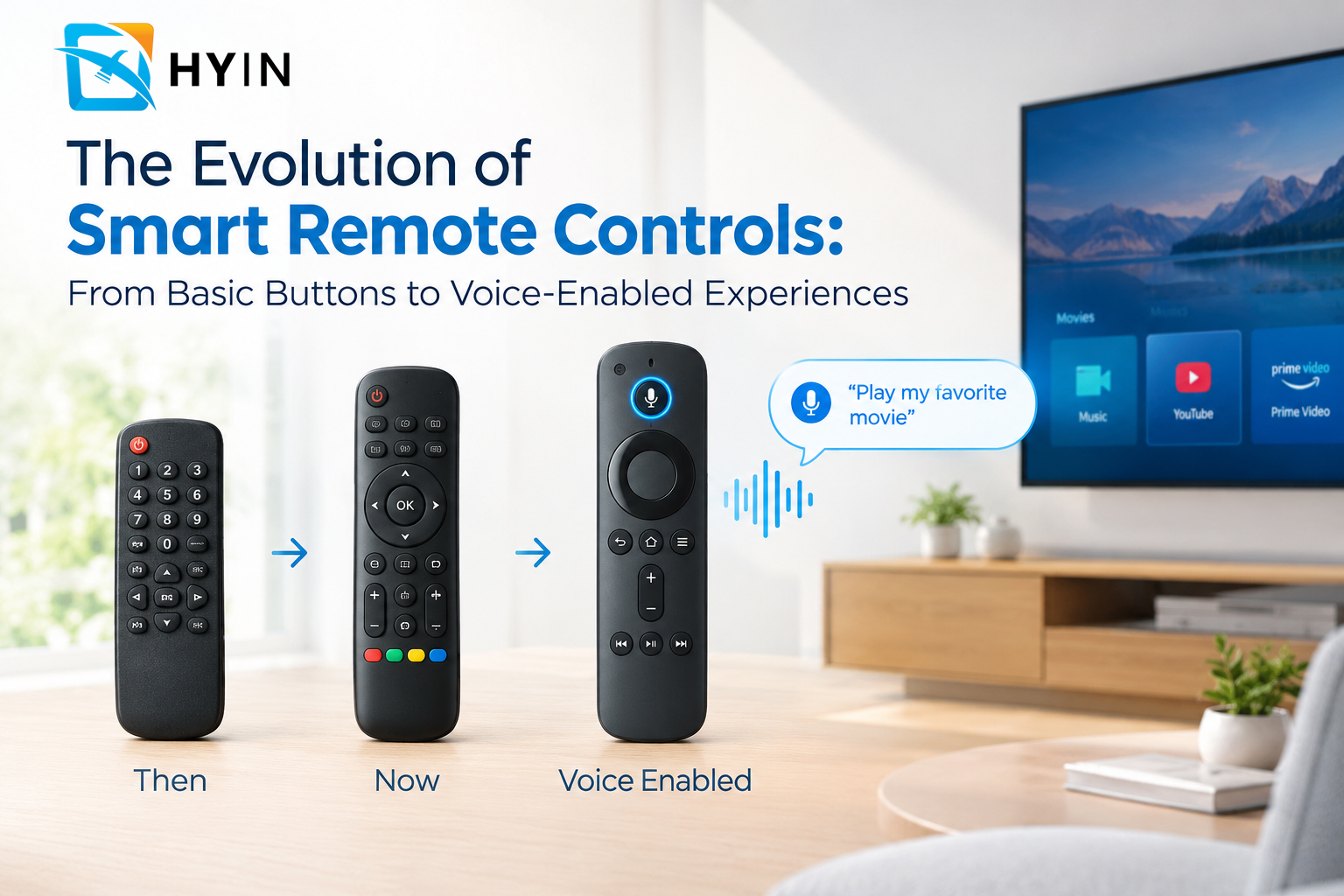
Remote controls have changed significantly over the years. What began as a simple way to operate a television has developed into a more advanced interface for smart TVs, air conditioners, set-top boxes and connected home appliances.
For consumers, the change is straightforward. Devices are becoming easier to operate. For product manufacturers, however, developing a modern remote control involves much more than adding a few buttons or introducing a new feature. It requires the right combination of wireless technology, hardware, software, power management and user experience.
Understanding this evolution helps businesses make better decisions when developing a new product or upgrading an existing one.
How Remote Control Technology Has Evolved
Traditional remote controls were designed around a simple principle: press a button, send a signal and operate a device. Infrared technology made this possible at a relatively low cost and remains suitable for many everyday applications.
As consumer electronics became more advanced, expectations changed. Users wanted greater operating range, fewer connection issues and more convenient ways to interact with their devices.
This led to the wider adoption of radio frequency technology, Bluetooth connectivity and voice-enabled functions.
Today, smart remote control design brings several of these capabilities together, depending on the product and its intended use.
1. Infrared Remote Controls: Simple and Cost-Effective
An infrared remote control, commonly known as an IR remote, sends signals using infrared light. The user generally needs to point the remote towards the device’s receiver for the command to register.
IR remote controls remain common in televisions, air conditioners and other household electronics because the technology is established, relatively straightforward and economical to implement.
However, infrared has limitations. Physical obstructions and poor alignment can interrupt communication. It is not the most suitable option when a device needs to be controlled from behind a cabinet or without a clear line of sight.
For manufacturers, the decision to use infrared remote control technology depends on the product’s intended environment, required functions and target cost.
2. RF Remote Controls: Greater Flexibility in Operation
Radio frequency, or RF, remote controls transmit commands using radio waves rather than infrared light.
Depending on the technology and application, this can allow communication without pointing the remote directly at the receiver.CommentHighlight HY Electronics | Blog Articles 3 RF remote controls are used in applications such as garage doors, selected home appliances and other systems where operating flexibility is important.
The term RF covers several technologies and frequency bands. A 433 MHz remote, for example, is not identical to a 2.4 GHz wireless controller. Their performance depends on factors such as antenna design, transmission power, receiver sensitivity, interference and the operating environment.
For an OEM remote control project, selecting the appropriate RF solution begins with understanding how the enduser will operate the product. Range, response time, power consumption, cost and regulatory requirements all need consideration during development.
3. Bluetooth Remote Controls: Designed for Connected Devices
Bluetooth remote control technology has become important in connected consumer electronics, including smart TVs and set-top boxes.
Unlike traditional infrared systems, Bluetooth can support operation without direct line of sight. It can also enable communication between paired devices and support features such as voice input, depending on the hardware and software configuration.
Bluetooth Low Energy can help reduce power consumption, making it useful for products where battery life matters. Actual performance depends on the selected components, firmware, usage patterns and overall system design.
For manufacturers, developing a Bluetooth remote control involves more than integrating a wireless module.
Pairing, connection stability, compatibility, antenna placement and power management must work together to deliver a consistent user experience.
4. Voice Remote Controls: A More Natural User Experience
Voice control has introduced another way for users to interact with electronic devices. Instead of navigating every menu manually, users can speak commands or search for content using a microphone integrated into the remote.
A voice-enabled remote control may combine Bluetooth or another wireless protocol with microphones, a processor, firmware and the necessary audio-processing capabilities. Some designs also include dedicated
buttons, backlighting or other features to improve usability.
Texas Instruments identifies low-power operation, wireless connectivity, user-friendly interfaces and accurate near-field voice recognition as important considerations in RF smart remote control design.
However, adding voice functionality also introduces design decisions around component selection, acoustic performance, processing requirements, cost and battery life.
For manufacturers, the goal should not simply be to include voice control because it is available. The feature should solve a genuine user problem and work reliably within the intended product ecosystem
What This Means for Remote Control Manufacturers
The development of smart remote controls has increased the importance of integration. Wireless communication, hardware design, firmware, industrial design and production quality can no longer be treated as entirely separate considerations.
A remote control that works well in a prototype may still require refinement before it is ready for mass production.
The antenna may need adjustment, the battery life may fall short of expectations, or the button layout may not suit the intended user.
Manufacturers should consider the following areas early in the development process.
- Technology selection: Choose between IR, RF, Bluetooth or a combination of technologies based on the product’s requirements.
- Hardware and firmware integration: Ensure that the electronic components, software and communication protocols work together as intended.
- Power management: Design for the expected battery life, standby consumption and frequency of use.
- Industrial design and usability: Consider the remote’s shape, button placement, materials and ease of operation.
- Testing and quality control: Validate connectivity, response time, durability and performance before scaling production.
An experienced remote control manufacturer can help coordinate these requirements across design, development, tooling, assembly and quality control.
How to Choose the Right Technology for a New Product
There is no single wireless technology that is best for every remote control. The right choice depends on the product, its users and the environment in which it will operate.
- Cost-effective, direct operation: Infrared.
- Wireless operation without direct pointing: RF, depending on the application.
- Connected devices and pairing: Bluetooth.
- Voice search and voice commands: Bluetooth or another suitable wireless platform, with compatible audio hardware and software.
- Multiple functions or device ecosystems: A carefully evaluated combination of technologies.
This is a starting point, not a substitute for technical evaluation. Range, compatibility, regulatory requirements and ower consumption must be assessed for the specific product.
Before beginning development, manufacturers should define the essential functions, target production cost, expected battery life, operating environment and compatibility requirements. These details make it easier to select an appropriate design and avoid expensive changes later.
The Future of Smart Remote Control Development
Remote controls may appear to be small accessories, but they remain an important part of how people experience electronic products. As connected devices become more capable, the remote must keep pace with changing expectations around convenience, reliability and ease of use.
For product brands, this creates an opportunity to improve the user experience through thoughtful design and suitable technology. For manufacturers, it creates a need for stronger coordination between research and development, hardware engineering, software development and production.
At HY Electronics, remote control development covers areas including exterior design, mould development, software and hardware development, assembly and quality control. Its associated Huayun manufacturing website also lists infrared, RF, Bluetooth and voice-enabled remote control solutions for different applications.
Developing a new remote control product? The process starts with understanding your requirements and matching them with the right technical and manufacturing approach. Visit https://hyinelectronics.com/ to explore your project requirements and discuss potential development options.